
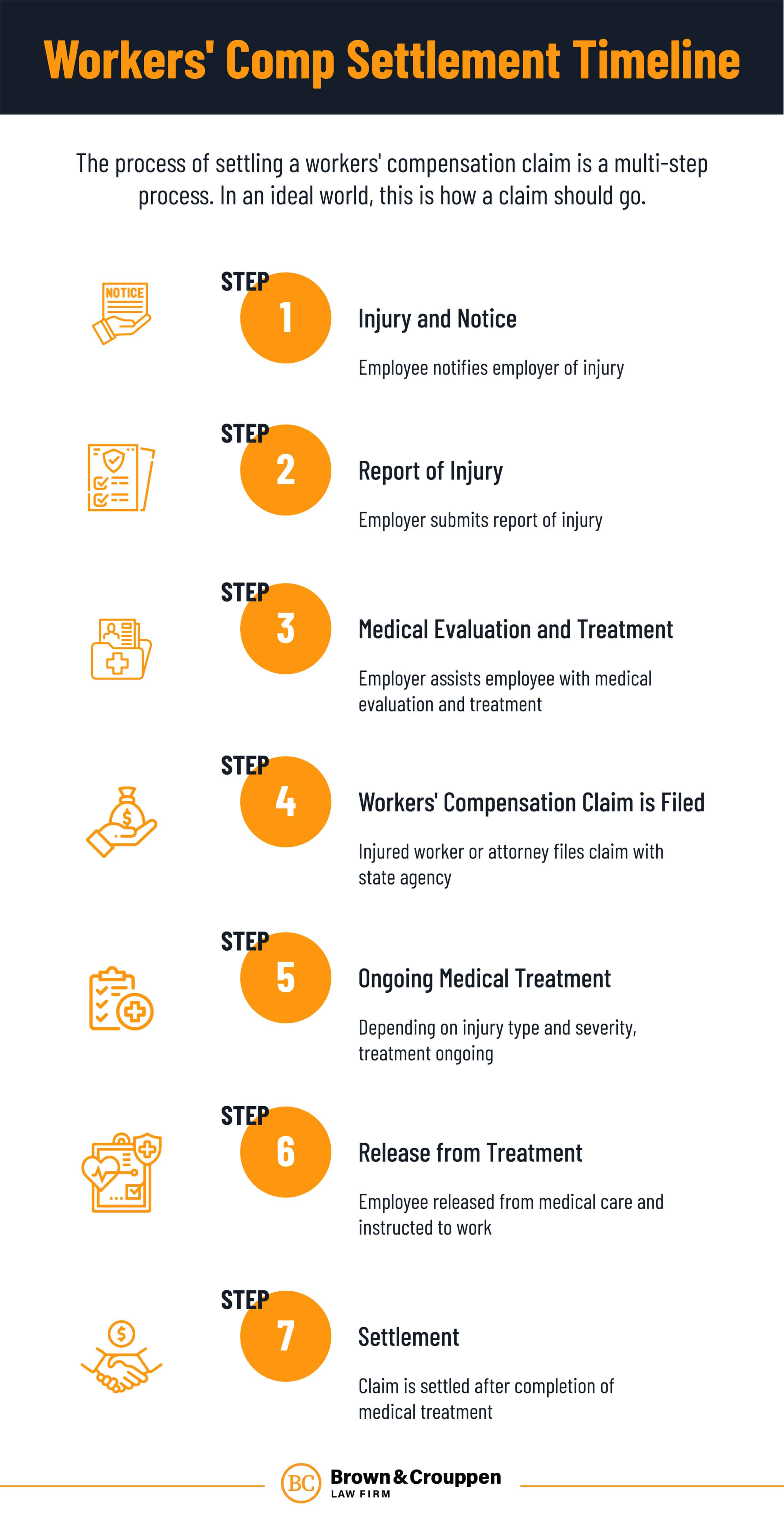
Most workers’ compensation settlements in Missouri and Illinois wrap up within a few months, depending on how long medical treatment lasts and whether the insurer fights the claim. However, excessive delays and insurance issues can push claims over a year.
A Missouri or Illinois workers’ compensation attorney pushes the timeline forward by tracking treatment, challenging low ratings, and pressing the insurer to put real money on the table.
Quick Answer: How Long Do Workers' Comp Settlements Take?
Key Takeaways for Workers' Compensation Timeline
- Maximum Medical Improvement (MMI) often marks the point when settlement talks begin because both sides have a clearer picture of your long-term medical needs.
- Missouri uses a body-part schedule, while Illinois ties values to a percentage of a person or body part.
- Adjusters often open low, and counteroffers backed by treating-doctor opinions tend to move the number up.
- Settlements typically require approval by the state workers’ compensation system before payment goes out.
- When delays are holding up your benefits, a workers’ compensation lawyer can intervene and help move your case along.

The Hidden Timeline Factors Behind a Workers' Compensation Settlement
A workers’ compensation settlement closes your claim in exchange for a lump-sum payment, a structured settlement, or another negotiated resolution. But while many injured workers focus on the insurer, the timeline often depends more on medical evidence and state approval requirements than anything else.
Several practical issues can affect how long a workers’ comp settlement takes:
- Length of Medical Treatment: Active treatment often needs to run its course before the parties can accurately value the claim.
- Surgery Recommendations: A pending surgery, disputed procedure, or denied treatment request can slow settlement negotiations.
- Average Weekly Wage Disputes: Disagreements over wage calculations can affect lost wages and the overall settlement value.
- Independent Medical Examinations: Insurance companies may request additional evaluations before making or increasing a settlement offer.
What Is Maximum Medical Improvement?
Maximum Medical Improvement (MMI) is often the point when meaningful settlement discussions begin. Until a doctor determines that your condition has stabilized, it’s difficult to measure permanent impairment, future medical care needs, or the long-term impact of a work-related injury.
Both Missouri and Illinois require enough medical evidence to place a value on the claim before a settlement agreement makes sense. Reaching MMI often gives everyone a clearer picture of what fair compensation looks like.
Settling too early can leave future medical expenses, additional treatment, or permanent work restrictions out of the equation.
Local Agencies Can Affect How Long a Settlement Take
The approval process can delay your workers’ comp settlement. Missouri claims are handled by the Division of Workers’ Compensation, which conducts hearings in St. Louis, Kansas City, Springfield, and other regional offices.
Workers’ compensation settlements don’t move through the system in isolation. In Illinois alone, more than 34,366 new claims entered the system in FY 2024. This volume sometimes causes delays.
Illinois claims proceed through the Illinois Workers’ Compensation Commission, including hearing sites such as Collinsville for many southern Illinois workers.
Hearing schedules, case volume, and administrative requirements can all influence how quickly a workers’ compensation case moves toward resolution.
How Medical Records Shape the Pace of Settlement Discussions
Medical records may play a significant role in evaluating permanent impairment, future medical care, and disability benefits. When the medical evidence is complete and well-documented, settlement negotiations often move more efficiently.
Use our guide to make a full recovery, understand the workers’ comp process, and learn about key legal considerations regarding your claim.
What Slows Down a Workers' Compensation Settlement the Most?
The single biggest slowdown in a workers’ compensation settlement is reaching MMI, followed by disputes over treatment, wages, and permanency ratings. Insurers can’t fairly value future limits until doctors finish active treatment, so almost everything else waits behind that gate.
Medical Treatment and MMI Disputes
Authorized doctors in Missouri sometimes return a worker to full duty before their injury fully stabilizes, forcing the worker to seek additional care or a second opinion. Illinois workers often have wider doctor choice, but specialist referrals and surgery approvals still drag.
Each delay in an MRI, a steroid injection, or a surgical consult can delay your settlement.
Wage Calculation Fights
Average weekly wage controls how big the temporary and permanent checks look, and adjusters often build that number from base pay only. A worker who pulled steady overtime at a St. Louis warehouse, or worked a second job at a Belleville restaurant may see a low calculation unless someone pushes back.
Correcting the wage moves every later number, including the workers’ compensation settlement value.
Permanency Rating Battles
Once you hit MMI, the treating doctor assigns a permanency rating, which is the medical opinion about lasting limits. The insurer’s doctor often gives a much smaller rating after an independent medical examination, and that gap becomes the heart of the settlement fight.
Bridging that gap with detailed treating-physician opinions usually adds weeks or months, but also raises the value of your settlement.
How Do Insurers Calculate a Workers' Compensation Settlement in Missouri and Illinois?
In Missouri and Illinois, insurers calculate workers’ compensation settlements based on the average weekly wage, the permanency rating, and the affected body part or system. The math is simple on paper but flexible in practice, which is where negotiation lives.
Missouri uses a body-part schedule. Each body part has a number of weeks, and a worker with a shoulder injury rated at a certain percentage receives that percentage of those weeks times the permanent partial disability rate.
Illinois uses similar building blocks, but its values often run higher and tie into a person-as-a-whole concept for some injuries.
Several inputs feed the workers’ compensation settlement calculation:
- Average Weekly Wage: The 52-week pay average controls every benefit rate that follows.
- Permanent Partial Disability Rate: State law fixes a per-week dollar figure based on that wage.
- Body Part or Body System Rating: The treating doctor assigns a percentage of loss after MMI.
- Future Medical Needs: Future surgeries or ongoing therapy can push value upward.
- Loss of Earning Capacity: Workers who cannot return to their old jobs often see larger settlements.
The numbers matter, but so does the story the evidence tells. A clear accident report, helpful coworker statements, and consistent medical records can strengthen your workers’ compensation settlement position.
Gaps in treatment, missed appointments, or social media posts that don’t match your restrictions can give the insurance company room to argue for less.
Can You Settle a Workers' Comp Case While Still Treating?
You can sometimes settle a workers’ compensation case while still treating, but doing so before MMI carries real risk. Most lawyers advise waiting until treatment ends, because settling early often creates uncertainty about future medical costs and treatment needs.
Some workers do choose to settle early. A worker who has a new job lined up, who wants to move out of state, or who needs cash to keep the lights on may push for a faster workers’ compensation settlement.
In those cases, the agreement should be priced with future surgery, therapy, and medication in mind, not just the current bills.
Three patterns show up in early settlement talks:
- Open Medical Settlements: The cash portion closes, but the insurer continues to pay for approved future care.
- Closed Medical Settlements: A larger lump sum closes out medical rights, ending the insurer’s duty to pay future bills.
- Structured Settlements: Payments stretch over months or years, often used for serious injuries or younger workers.
Medicare set-asides add another layer for workers near retirement or on disability. A Medicare set-aside is a portion of the settlement reserved for future injury-related care, and it slows finalization while the parties get the figure right.
Settling at the wrong time can turn a fair-looking check into a future bill problem, especially for shoulder, back, and knee injuries that often need follow-up surgery years later.
Why Legal Help Can Matter During a Workers' Comp Claim
A workers’ comp lawyer moves your case towards a resolution by sharpening the medical record, correcting wage math, and forcing the insurer to negotiate against real evidence. The work happens in steady steps, not one dramatic moment.
Here’s how a lawyer can help you recover a fair workers’ compensation settlement:
- Average Weekly Wage Audit: Your attorney pulls pay stubs, tax forms, and second-job records to push the wage figure up.
- Treating-Doctor Coordination: A lawyer asks the treating physician for a detailed permanency report that answers the insurer’s medical exam.
- Medical Examination Response: Your attorney challenges low ratings with cross-examination and supplemental records.
- Hearing Preparation: As a hearing approaches, the insurance company must weigh the risk of an unfavorable decision, which can create momentum for more productive settlement discussions.
- Settlement Document Review: Your workers’ comp lawyer reads every line of the stipulation, especially open medical, future surgery, and Medicare set-aside terms.
FAQ for Workers' Compensation Settlement
Most workers receive payment within two to six weeks after a judge or arbitrator approves the settlement. The state agency reviews the paperwork, signs the approval order, and the insurer then issues the check, with mailing or direct deposit timing varying by carrier.
You don’t have to accept the insurer’s first offer in a workers’ compensation case. First offers are almost always lower than the case is worth, and you have the right to negotiate, request mediation, or take the case to a hearing if talks stall.
An attorney can review the offer you received, explain whether it accounts for your medical needs and lost wages, and build the evidence needed to negotiate for more if it falls short.
Reopening a workers’ comp case after settlement is generally difficult, and in most situations, the agreement closes the claim for good. Some Missouri and Illinois settlements keep medical benefits open for a set period, which allows future treatment, but the cash portion usually doesn’t reopen.
Workers’ compensation settlements are generally not taxable under federal, Missouri, or Illinois income tax rules. Workers on Social Security Disability sometimes see an offset, and structured settlements may carry their own tax notes, so a tax professional should review larger payouts.
A fair settlement can be hard to judge without knowing what your injury may cost later. An attorney can review the total amount, the body parts covered, the permanency rating, and future medical terms to see whether the agreement protects you or leaves too much out.
Before you sign, it helps to have someone who knows workers’ comp settlements read every line and explain what the agreement actually gives up.

Get started with a free consultation with one of our skilled Personal Injury Lawyers today.
Ready To Talk About Your Settlement?
Since 1979, Brown & Crouppen, P.C. has helped Missouri and Illinois workers close out claims with the kind of preparation that adjusters take seriously. Straight talk, steady updates, and a team that has guided clients through thousands of trials means you’ll know what your workers’ compensation settlement is really worth before you sign anything.
Call (314) 501-9510, connect with our team online, or visit any one of our nine full-service offices throughout Missouri and Illinois for a free consultation.