
Pedestrian accidents are some of the most devastating incidents on Missouri roads. When a person on foot is struck by a vehicle, the injuries are often severe, the recovery is long, and the financial impact can feel overwhelming. If you or a loved one has been hit by a car, it’s natural to wonder what a fair settlement looks like and how Missouri law affects your ability to recover.
While no two cases are the same, understanding the average pedestrian accident settlement in Missouri, and the factors that influence it, can help you feel more informed and empowered as you move forward.
What Is the Average Pedestrian Accident Settlement in Missouri?
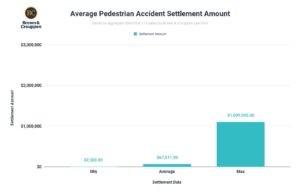
There is no single statewide database that publishes an official “average” settlement amount for pedestrian accidents. However, based on publicly reported verdicts, insurance data, and trends seen across Missouri personal injury cases, pedestrian accident settlements commonly fall within a broad range of $25,000 (representing the state minimum insurance policy limit) to well over $500,000, depending on the severity of injuries and the degree of fault.
Severe injury cases (such as those involving fractures, surgeries, traumatic brain injuries, or permanent disability) are often resolved for six-figure amounts. Catastrophic injury or wrongful death cases can reach seven figures.
Because pedestrian accidents frequently involve high-impact trauma, the settlement value tends to be higher than typical auto-collision cases.
It’s important to remember that every case is unique. Missouri law requires a specific analysis of liability, damages, and insurance coverage. Your settlement may fall below, within, or far above these ranges depending on your circumstances.
Why Pedestrian Accident Settlements Tend to Be Higher
Pedestrians have no physical protection. Even a low-speed impact can cause life-altering injuries. Common injuries include broken bones, torn ligaments, traumatic brain injuries (TBIs), spinal injuries, internal injuries, scarring and disfigurement.
These injuries often require emergency care, surgery, hospitalization, physical therapy, and long-term follow-up treatment. Medical bills alone can easily exceed tens of thousands of dollars.
When you combine medical costs with lost wages, pain and suffering, and long-term limitations, the value of a pedestrian accident claim naturally increases.
Key Factors That Affect Your Settlement in Missouri
Every pedestrian accident is shaped by a unique combination of facts. Below are the most important factors that influence your payout.
1. Severity of Injuries and Medical Treatment
This is the single biggest driver of settlement value. Higher settlements are associated with surgeries, hospitalization, long-term physical therapy, permanent impairment, chronic pain, and scarring or disfigurement.
Insurance companies heavily weigh the type, duration, and cost of medical treatment. In Missouri, medical bills are admissible as evidence of damages, even if they were reduced by insurance.
2. Lost Wages and Loss of Future Earning Capacity
If your injuries kept you out of work—or will limit your ability to work in the future—your settlement should reflect missed paychecks, lost bonuses or overtime, reduced hours, inability to return to your prior job, and permanent disability. These economic losses can significantly increase the value of your claim. However, the legal world relies on evidence to support these claims. If you are claiming lost wages, you need to be able to prove your income and that you were off work resulting in the loss of income, but also that the incident is the reason you lost the income. The income and lost time can be established with a lost wage affidavit completed by your employer. The connection between the injury and the need to be off work can be established by a recommendation from your doctor.
3. Pain and Suffering
Missouri allows recovery for both physical and emotional harm, including physical pain, emotional distress, anxiety or PTSD, loss of enjoyment of life, and loss of independence. Pedestrian accidents often involve traumatic circumstances, which can increase non-economic damages.
4. Comparative Fault Under Missouri Law
Missouri follows pure comparative negligence (Mo. Rev. Stat. § 537.765). This means your compensation is reduced by your percentage of fault.
For Example: If your damages total $200,000 but you are found 20% at fault, your recovery becomes $160,000.
Insurance companies frequently argue that pedestrians share fault, such as crossing outside a crosswalk or wearing dark clothing at night. An attorney can push back against these tactics.
5. Insurance Coverage Available
Your settlement cannot exceed the available insurance coverage unless the defendant has significant personal assets.
Sources of recovery may include:
- The driver’s liability insurance
- The vehicle owner’s insurance
- Commercial insurance (if the driver was working)
- Your own uninsured/underinsured motorist (UM/UIM) coverage
- MedPay coverage
Missouri requires drivers to carry only $25,000 per person in bodily injury coverage. Many pedestrian cases exceed that amount, making UM/UIM coverage extremely important.
6. Strength of Liability Evidence
Clear evidence of driver negligence increases settlement value, including evidence of speeding, distracted driving (such as texting and driving), failure to yield, running a red light, and impaired driving (either through legal or illegal substances). Evidence such as surveillance footage, eyewitness statements, police reports, and accident reconstruction can strengthen your case.
I’ve had many clients have come to me and said something along the lines of, “I believe the defendant was intoxicated” or “I think they were texting and driving.” But if there’s nothing on the police report and no charges filed, and we don’t have any other evidence beyond that gut feeling, it’s not always not strong enough to support their claim. On the other hand, if the defendant is actually arrested and charged with a DUI, and they eventually plead guilty or are convicted, that’s a whole different ball game. That kind of concrete evidence is significantly stronger and can really bolster the value of the settlement. So, it’s important to understand how crucial that level of evidence is when we’re building a strong case.
It’s important to know that just because a police report says the other driver is at fault, that won’t necessarily make the insurance adjuster automatically accept liability. The officer’s conclusions on how the crash happened are useful information, but they actually can’t be presented to the jury as the final say on who’s at fault. It’s really up to the jury to make that decision. Now, the officer can certainly testify about what they saw and the conversations they had at the scene, but they can’t tell the jury outright who is responsible. So, while that police report is a helpful piece of evidence, it doesn’t single-handedly determine the outcome of the case.
In one recent trial I handled, the officer had actually done a full reconstruction at the scene of the accident. Because of that, we were able to present a diagram to the jury that showed the layout of the scene in detail, and the officer could testify about all sorts of facts related to how the crash happened. The jury got to see his full workup, which was part of the police report, and that added real clarity to the case.
On the other hand, in another case that almost went to trial, we ran into a different situation. The judge didn’t allow that police diagram to be admitted to the jury because, in this instance, the officer hadn’t done a full reconstruction. Instead, the diagram was largely based on statements from the parties involved, and the judge found it to be hearsay and inadmissible. So, while a diagram can be a helpful piece of evidence, it really depends on the foundation behind it to determine whether it can actually be shown to the jury.
7. Location of the Accident
Certain intersections and roadways in Missouri (especially in population dense cities such as St. Louis and Kansas City) are known for high pedestrian crash rates. Dangerous locations can support arguments that drivers should have exercised greater caution.
According to pedestrian and public transportation advocacy group Trailnet’s 2024 Annual Crash Report emphasized that many of the pedestrian accidents in the St. Louis region are isolated to certain roads, including Grand, Kingshighway, Broadway, Gravios, Lindbergh, Halls Ferry, Manchester and Big Bend. Drivers that frequent these areas should be aware that there is a high concentration of foot traffic in the area and exercise greater caution.
Another environment where I frequently see pedestrian–vehicle collisions is in residential neighborhoods lined with parked cars. These areas create natural blind spots, and drivers often underestimate how limited their visibility becomes when vehicles are stacked along both sides of the roadway.
In my own practice, I’ve represented children who were injured in exactly these circumstances. In one case, a young child was riding their bicycle on the sidewalk and entered a marked crosswalk in their neighborhood. Parked cars along the roadway completely blocked the driver’s view, and as the driver turned right, they struck the child simply because they never saw them.
In another case, a child emerged between two parked cars, and the driver claimed the child “darted out” into the street. Situations like these raise questions about comparative fault, and depending on a child’s age and reasonableness, they may bear a small portion of responsibility. But the law also recognizes that drivers in residential areas must anticipate exactly this kind of hazard. When you’re driving through a neighborhood where children play, ride bikes, and move unpredictably, you are expected to slow down, scan carefully, and be prepared for limited sightlines.
These cases illustrate why the physical layout of a street matters. Parked cars create visual obstructions, and drivers who choose to travel at normal speeds through these areas are ignoring a known risk. When a crash occurs, those conditions can strongly support the argument that the driver should have exercised greater caution.
8. Quality of Legal Representation
Insurance companies track which law firms are willing to take cases to trial. When a firm has a reputation for strong litigation, adjusters tend to offer higher settlements.
A skilled attorney will:
- Gather evidence
- Work with medical experts
- Calculate long-term damages
- Negotiate aggressively
- Prepare the case for trial if necessary
This often results in significantly higher compensation.
Use our guide to understand what to do after being hit by a car and key legal considerations.
Common Damages in a Missouri Pedestrian Accident Claim
Your settlement may include compensation for medical bills (past and future), lost wages, loss of future earning capacity, pain and suffering, emotional distress, scarring or disfigurement, loss of enjoyment of life, and/or wrongful death damages (if applicable). Each category must be supported by evidence, documentation, and expert opinions when necessary.
How Long Does a Pedestrian Accident Settlement Take?
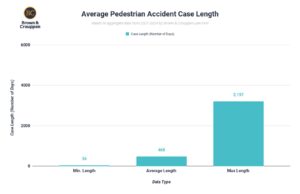
Most cases resolve within 6 to 18 months, depending on length of medical treatment, complexity of liability issues, insurance company cooperation, and whether litigation becomes necessary. Cases involving severe injuries or disputed fault may take longer, especially if they proceed to trial.
It is often difficult to understand what the case value should be for an injury claim, particularly where you’ve never been through an injury claim before. Therefore, it’s important to seek out those who have significant experience in negotiating injury claims to guide you to an appropriate settlement.
All auto crashes are scary, but especially if you aren’t in a car. If you or a loved one has been injured as a pedestrian, contact Brown & Crouppen for a free consultation.